What Film Sound Design Does for a Story
Film sound design is the planning, creation, and organization of all sounds that accompany moving images, including dialogue, sound effects, music, and subtle background noise. Instead of accepting whatever a microphone records, practitioners deliberately shape the audio track so it supports the story. A quiet room with faint traffic outside suggests a different mood than the same setting filled with distant sirens or a low mechanical hum. Such choices guide audience attention, shape interpretations of events, and influence how viewers feel about characters, even when individual sounds are not consciously noticed.
An important part of this process is the use of ambient sound in film, such as wind, room tone, crowd murmurs, or building ventilation. These background elements define the space of the action and keep the audio from feeling empty or artificial. Carefully adjusted ambience can signal changes in location, time of day, or tension level without explicit explanation in the dialogue or visuals. At the same time, sound teams work within limits: playback systems cannot reproduce every nuance of real life, listening environments differ, and production schedules can restrict how detailed the soundtrack becomes. Within these constraints, sound design still provides tools to clarify the narrative, support performances, and build a convincing world around the images.
Core Building Blocks of a Film Soundtrack
A film soundtrack is built from several categories of sound that shape how viewers understand the story. In film sound design, an important distinction is between diegetic and non-diegetic elements. Diegetic sound comes from sources within the world of the film, such as footsteps in a hallway, a phone ringing, or a song playing on a character’s radio. Non-diegetic sound is added for the audience but does not belong to the story world, such as a dramatic orchestral score or a brief musical sting that highlights a cut or reaction. Filmmakers use this contrast to guide attention, clarify whether characters hear a sound, and signal shifts in mood or point of view, so some audio feels embedded in the environment while other layers function more like commentary.
Within these broad categories, ambient sound and other background layers make scenes feel coherent and believable. Ambient sound in film includes environmental noise such as distant traffic, room tone, soft wind, or the murmur of a crowd, and it is usually mixed so viewers do not focus on it directly. Audiences may not consciously notice these textures, but removing them can make a scene seem empty or artificial. Sound designers balance ambient beds with more prominent elements like dialogue and specific effects, deciding how much detail supports the story and when restrained sound or near silence is more appropriate. These choices are shaped by practical factors, including the quality of original recordings, the need to avoid distracting noise, and limits on time in post-production.
| Sound type | Perceived source | Typical story function | Audience notice level |
|---|---|---|---|
| Diegetic sound | Inside the story world | Clarify space, actions, character presence | Medium |
| Non-diegetic sound | Outside the story world | Guide emotion, pace, point of view | Medium to high |
| Ambient sound | Environment within the story | Create cohesion, realism, sense of place | Low unless missing or exaggerated |
Diegetic and Non-Diegetic Sound Explained
In film sound design, diegetic sound is any audio that belongs to the story world and could be heard by characters, such as onscreen dialogue, footsteps created with Foley sound effects, or a radio playing in a room. Non-diegetic sound is added only for the audience and does not exist for the characters, like a musical score or a narrator describing events. This distinction helps sound editors and mixers decide how to treat different elements so viewers can tell which sounds are part of the narrative space and which are shaping their emotional or intellectual response. In practice the line is not always strict, and filmmakers sometimes blur it, for example when a score gradually turns out to come from a visible source on screen or a voice-over shifts into something a character appears to hear. Because of these gray areas, sound teams often rely less on rigid labels and more on how each choice supports clarity and mood for a particular film.
Ambient Sound and the Sense of Place
Ambient sound in film is the subtle bed of environmental noise that helps the audience understand where a scene is taking place and how it feels. In film sound design, elements such as room tone, distant traffic, soft wind, or a faint crowd murmur are layered underneath dialogue and music to create a believable acoustic space. Even when viewers are not consciously aware of these sounds, they shape the perceived size of a room, the time of day, and the emotional temperature of the scene. Because ambient tracks are often recorded or built from multiple sources, they can only approximate real locations, and practical limits like background pollution or missing production recordings mean the sound team must choose which details to include or omit rather than reproduce every nuance of the real world.
Foley and Other Sound Effects Work
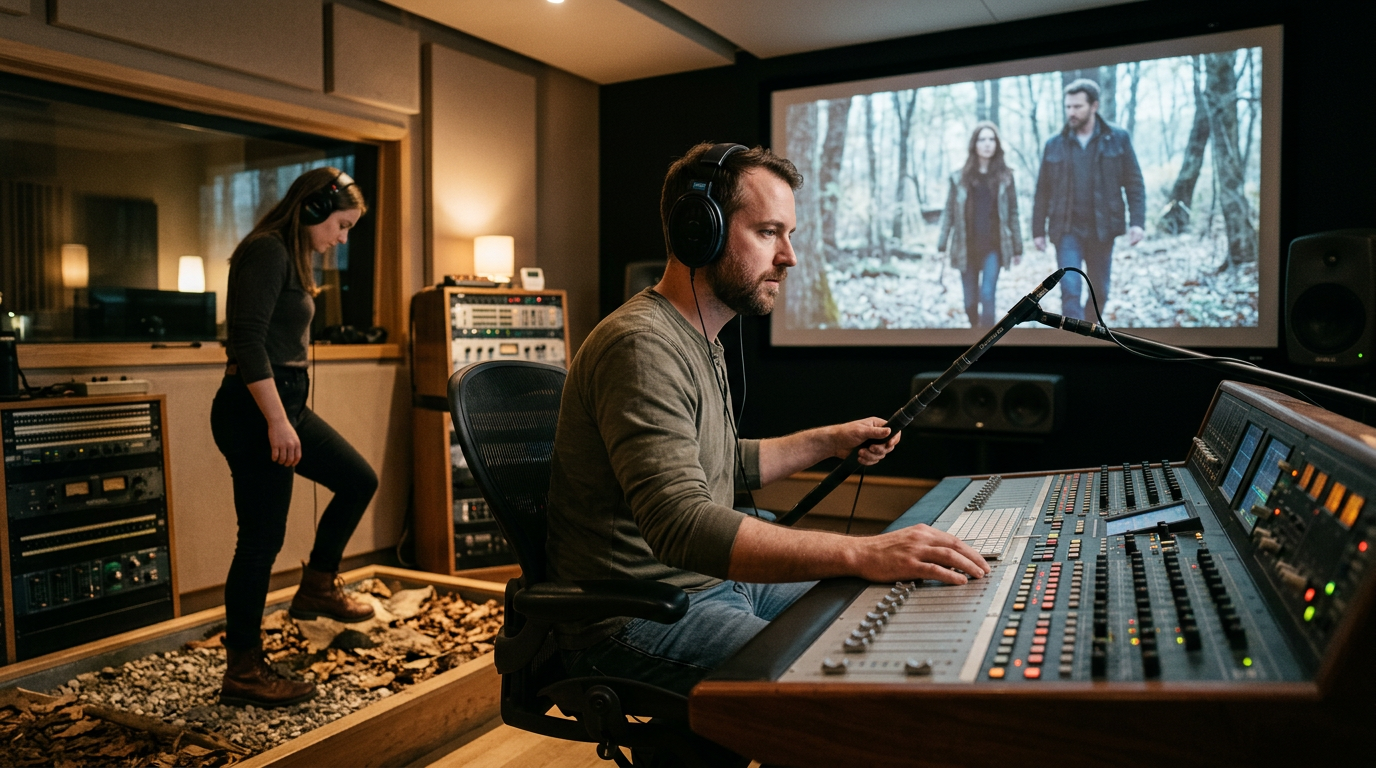
Within film sound design, Foley sound effects are custom recordings that recreate everyday actions such as footsteps, cloth movement, or the handling of objects. Foley artists work on a dedicated stage with varied surfaces and props, performing in sync with the picture while a mixer captures each sound as cleanly as possible. The aim is not perfect realism but a believable, emotionally suitable layer that supports the story and blends with production sound. Many subtle details, like jacket rustle or a glass set on a table, are often inaudible or unusable from on set recording, so Foley fills those gaps and can be shaped to emphasize character, mood, and point of view.
Beyond Foley, sound designers and editors rely on libraries and custom sessions to build harder effects such as explosions, vehicles, weapons, or stylized elements for fantasy and science fiction. These sounds are edited into layers, organized by type and perspective, then shaped with equalization, dynamics processing, and spatial treatments before being handed off to the film sound mixing stage. Practical limits such as budget, schedule, and available recording spaces restrict how many sounds can be created or how closely they can match each visual event. As a result, even highly detailed tracks balance realism, narrative clarity, and technical constraints rather than documenting every possible sound in the real world.
How Foley Sound Effects Are Performed
Foley sound is created on a dedicated stage where artists watch the locked picture and perform everyday noises in sync with on‑screen movements. The stage is laid out with different surfaces, props and materials to cover footsteps, clothing rustle, glass, metal and other textures. As scenes play back, the Foley team records several passes, often separating footsteps from cloth and small object handling, while adjusting microphone placement and performance intensity so the results blend naturally with the action rather than feeling like detached sound bites. Choosing between custom Foley and a sound library depends on how closely the effect must match the picture, how important it is to the story and what time and budget are available in post‑production. Distinctive movements, stylized close‑ups or gaps in production sound often rely on frame‑accurate Foley, while distant or generic actions can be covered with curated library recordings that are later shaped in the mix.
Q&A
-
What does film sound design contribute to the story beyond what microphones capture on set?
Film sound design shapes how viewers feel and interpret scenes by planning dialogue, effects, music, and background noise, rather than relying only on raw production recordings. -
How do diegetic and non-diegetic sound differ in a typical movie soundtrack?
Diegetic sounds come from the story world and could be heard by characters, while non-diegetic elements like score or stings are added for the audience and sit outside that world. -
Why is ambient sound important for creating a sense of place in film?
Ambient layers such as room tone, traffic, or distant voices suggest space, time, and mood, even though they only approximate real locations and cannot reproduce every detail. -
What are Foley sound effects, and why are they performed instead of using only location audio?
Foley sound effects are custom recordings of everyday actions performed in sync with the picture to replace or support production sound that is missing, noisy, or too faint. -
What does film sound mixing involve at the end of post-production?
Film sound mixing balances dialogue, music, ambient tracks, and effects into a coherent soundtrack, but choices are limited by available recordings, budget, and schedule.